Black Sherwani
2 PRODUCTS
Filter

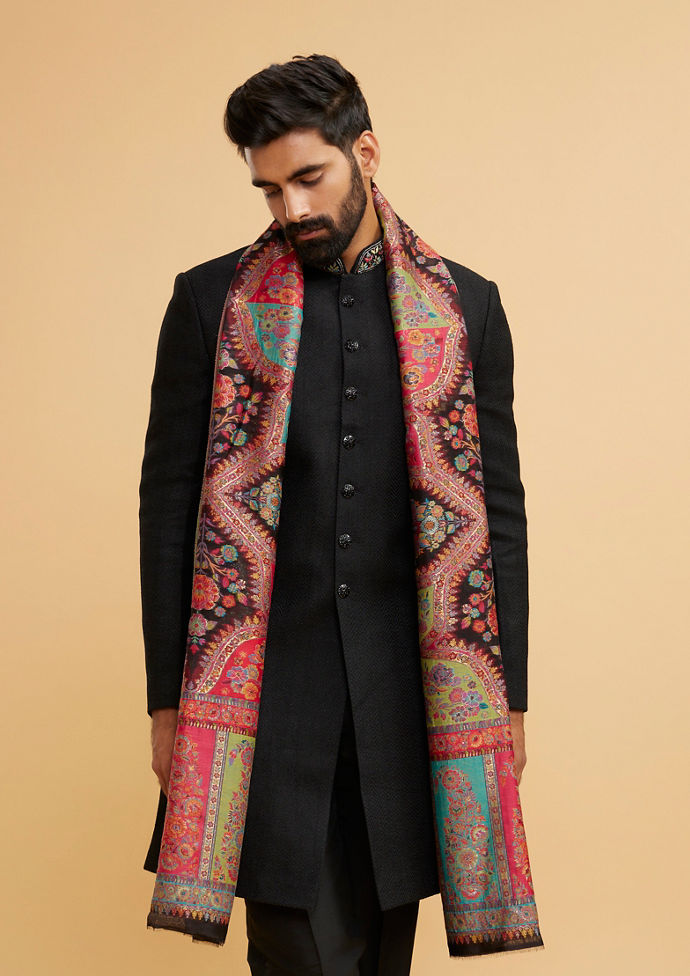
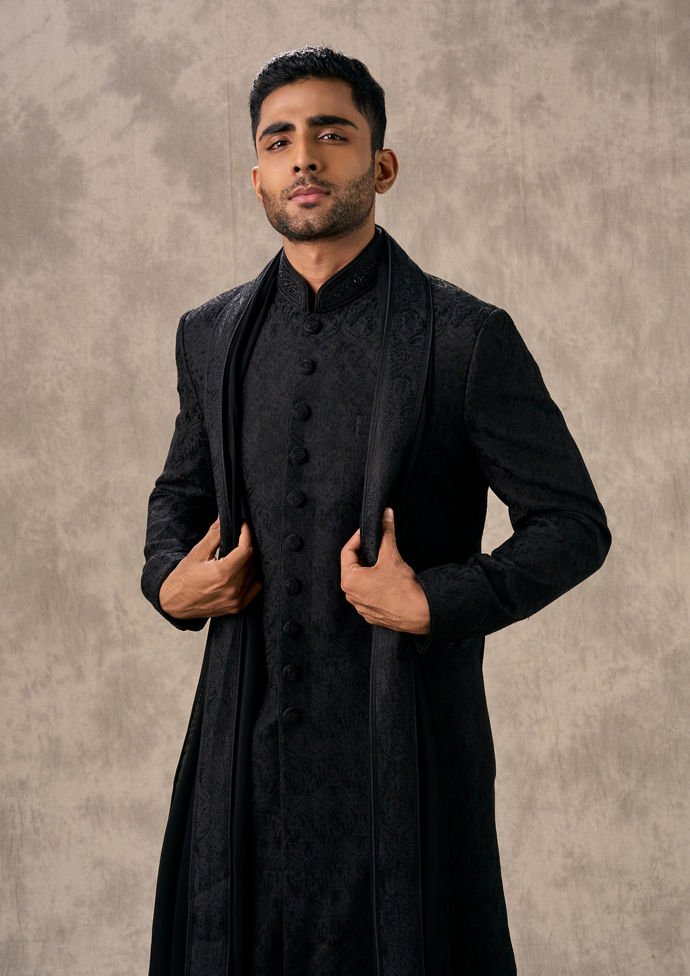
Our men's black sherwani collection gathers a small range of black pieces, among them the Black Textured Sherwani With Pashmina Shawl and the Black Silk Thread Embroidered Sherwani. All of them are made for Indian weddings and formal evenings, so you can settle on a groom or reception look without scrolling past colours you would never wear.
The difference between the pieces comes down to surface texture and embroidery, and that is what makes the decision quick. Below we explain what defines each one, compare them side by side, and walk through fit, fabric and care before you order.
Grooms wear them, and so do groomsmen, brothers of the bride, and guests at evening receptions. Black is the practical pick when the wedding party needs one look that photographs consistently indoors and out. Off-the-rack sizing typically runs XS through 3XL, with chest measurements from about 34 to 48 inches, and made-to-measure covers anyone outside that range. If you are ordering for a group, submit every measurement together so the embroidery and the shell come from a single production lot.
Structure is what keeps the garment sharp across a six-hour function. A wedding-ready piece has a stiffened stand collar, a reinforced placket, and a lined skirt with enough weight that it does not flap when you walk. Embroidery should sit flat against the cloth except where the technique calls for relief: zardozi and dabka stand up from the surface, while resham stays flush. Look at the buttons too. Hand-covered buttons anchored on a shank hold better than flat-sewn ones, which pull through the buttonhole on heavy silk.
Take measurements over the shirt you will wear underneath, not over a t-shirt. For the chest, wrap the tape around the fullest part of the chest, under the arms, and keep it level at the back. For the shoulder, measure seam to seam across the back from one shoulder point to the other. For the sleeve, start at the shoulder seam and run the tape to the wrist bone with the arm slightly bent. Add the length you want from the base of the neck at the back down to the hem, usually 40 to 46 inches. Write each number down twice and have someone else confirm the chest and shoulder figures before you order.
Cloth weight is the first thing to check. Look for shell fabrics in the region of 200 to 300 gsm, since this range holds embroidery without puckering, and silk-blend or wool-blend shells hang better than a light synthetic. Silk thread reads differently from polyester thread under evening light: it gives a slight sheen at the edge of each stitch instead of a glare. Inside, a full lining in bemberg or cotton-silk keeps the garment breathable, and a sewn-in hem facing gives the bottom edge weight so it falls straight.
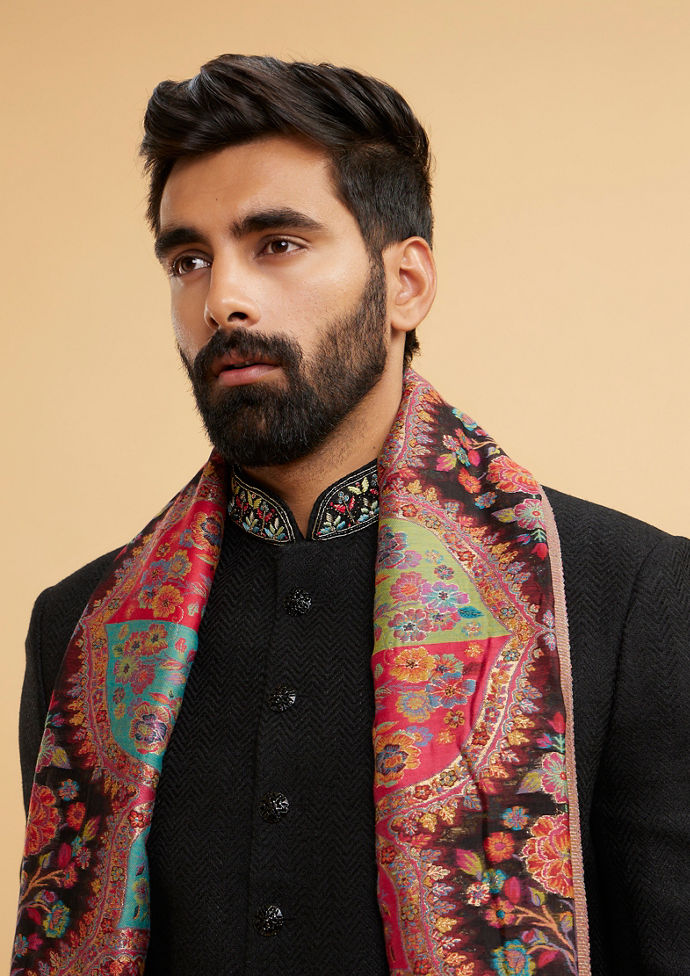
This one has a tonal textured weave across the body, and the pashmina shawl that comes with it adds weight at the shoulders. Neither piece carries embroidery, so the texture does the work.
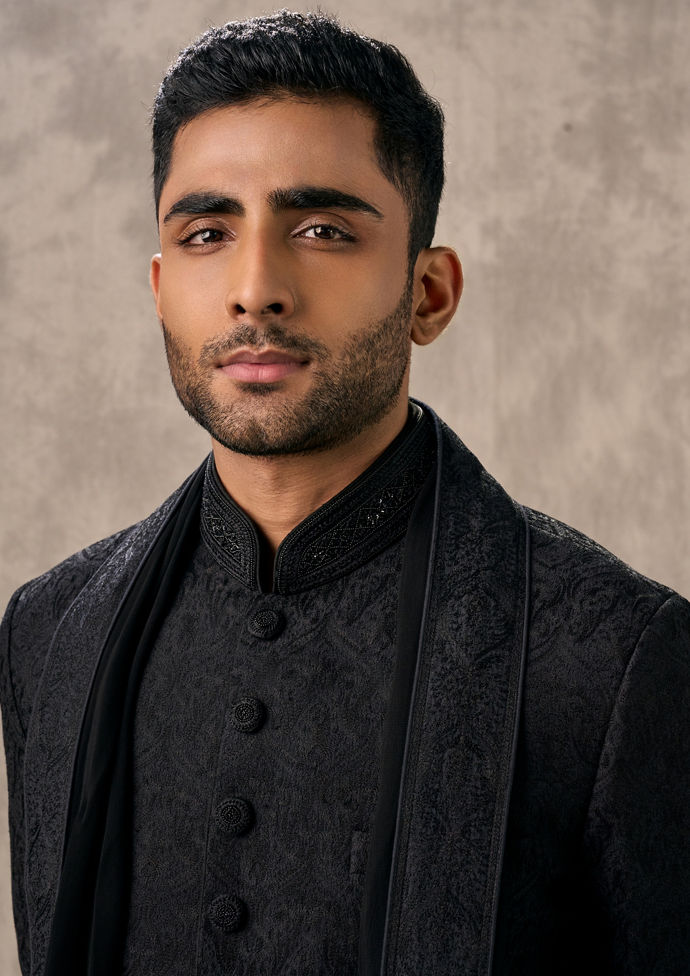
The embroidery here is black on black, stitched in silk thread down the placket and around the collar. Because the thread matches the base, you get raised relief instead of a colour contrast, which is why it still reads clearly under the warm light of a banquet hall.
Silver thread against a black base gives you the sharpest contrast of the four, so this is the pick for a reception stage where the lighting is bright. Keep the buttons and your mojaris in the same cool metal tone, and the outfit holds together as one look.
A self-textured weave carries the detail on its own, with no separate embroidery to snag or crease. That is what keeps the silhouette steady when a reception runs long.
Chest sizes run 40 to 46 inches, and lengths run 34 to 48 inches. Shorter frames sit best near the 34 to 40 inch end, where the hem clears the shoes. Taller grooms carry the longer lengths without bunching at the ankle.
Velvet in the 200 to 300 gsm range holds its shape through a long December evening, indoors or out. For an indoor sangeet in a heated hall, a lighter silk weave moves better and keeps you cooler.
Keep zardozi on the placket, collar, and cuffs. Silver thread on black holds its contrast under bright reception lighting, which is where most of your photographs will be taken.
Grooms wear the stole and churidar set, and guests can leave the stole off. Share your event date when you order so tailoring and delivery reach you with time in hand.
Embroidery reads differently on black than on lighter cloth. Zari thread catches light and shows a metallic sheen, while resham silk thread stays matte and builds depth through shadow. Check stitch density on the front panel, collar, and cuffs. Heavy work stiffens the cloth, so the sherwani should still lie flat across the chest when buttoned.
Contrast matters as much as density. Gold or copper thread on black reads formal, while black-on-black thread is quieter and works better for daytime functions. Look at the motif scale against the sherwani length, because large repeats can crowd a shorter hem.
Venue lighting decides how much detail shows up in photos. Warm tungsten and candlelight bring out gold or bronze thread on black. Cool LED uplighting flattens dark fabric and hides tone-on-tone work. For sangeet, where you will be moving, keep the lower skirt clear of heavy embroidery so the hem does not catch underfoot.
Reception venues often run a mix of flash photography and dim ambient light. A black sherwani with medium-density thread on the chest and shoulders photographs well under both, while an all-over dense pattern can blur into a single dark mass in low light.
Keep your metal to one family. Button thread should match the zari or resham work already on the chest, so leave the layered chains and heavy rings at home. If the sherwani has silver embroidery, an oxidised silver brooch or a plain silver-buttoned churidar matches that tone.
Fold along the shoulder seams and keep the embroidered front panel clear, then pad the placket with acid-free tissue. Velvet pressed flat inside luggage develops crushed pile, and on dark cloth those patches read as dull spots. Hang the sherwani within a day of arrival and store it in a breathable cotton cover. Skip the plastic. Our sherwanis are dry clean only, so plan the clean around the event rather than after it.
Matching mojaris in black or ivory keep the outline unbroken, and a stole of roughly 2.25 to 2.5 metres drapes over one shoulder without trailing. Pick the lighter stole for a sangeet because you will be moving, and the heavier woven version for a reception, where it stays put through photographs.
Two days ahead, wear the full set for ten minutes and confirm three points: the shoulder seam sits on the bone, the sleeve ends at the wrist bone, and both arms lift without the chest pulling. Book a shave or trim for the day before, not the morning, so any redness settles in time.
Yes. Go with silk or a cotton-silk blend and save the velvet for evening functions, since velvet holds heat through a noon ceremony and looks heavier in daylight. Keep the work light: zari or thread embroidery along the collar, placket and cuffs is plenty, and a plain stole finishes it without crowding the look.
A tailor can shorten the hem and taper the sleeves. Ask for roughly half an inch of extra fabric at the cuff so the sleeve ends at the wrist bone and a shirt cuff stays just visible underneath. Wear the shoes you plan to pair with it to the fitting, and have the hem fall about half an inch above the shoe.
Both. Groomsmen in plain black with matching stoles look consistent in photos, while the groom's version can carry denser zari on the collar and placket. Keep the silhouettes close to each other so the group reads as one set rather than five separate outfits.
Order 21 to 30 days ahead. That window covers a first fitting, one round of alterations and a final check. If you are ordering during peak wedding season or want custom embroidery, add another week.
Explore More Collections: Indo Western Dresses For Men , Jodhpuri Suit For Men
Black Sherwani Price List
Black Sherwani
Price (₹)
Black Textured Sherwani With Pashmina Shawl
A$ 1,400
Black Silk Thread Embroidered Sherwani
A$ 2,600





Login to access Twamev Member Exclusive Features like Video Commerce
Enter the email address associated with your Manyavar account
We’ll ask for this password whenever you sign in